
A Palestinian Account of Restlessness
I picked up Mai Serhan’s memoir, I Can Imagine It for Us, early one morning this fall. The intention was to read it slowly over the week, to take notes. By night I was flat on the cold concrete of my patio after racing through to the end. I felt weighed. My stomach churned. The memoir did what tremendous writing does: fed you a morsel of lived life and left you struggling to digest it.
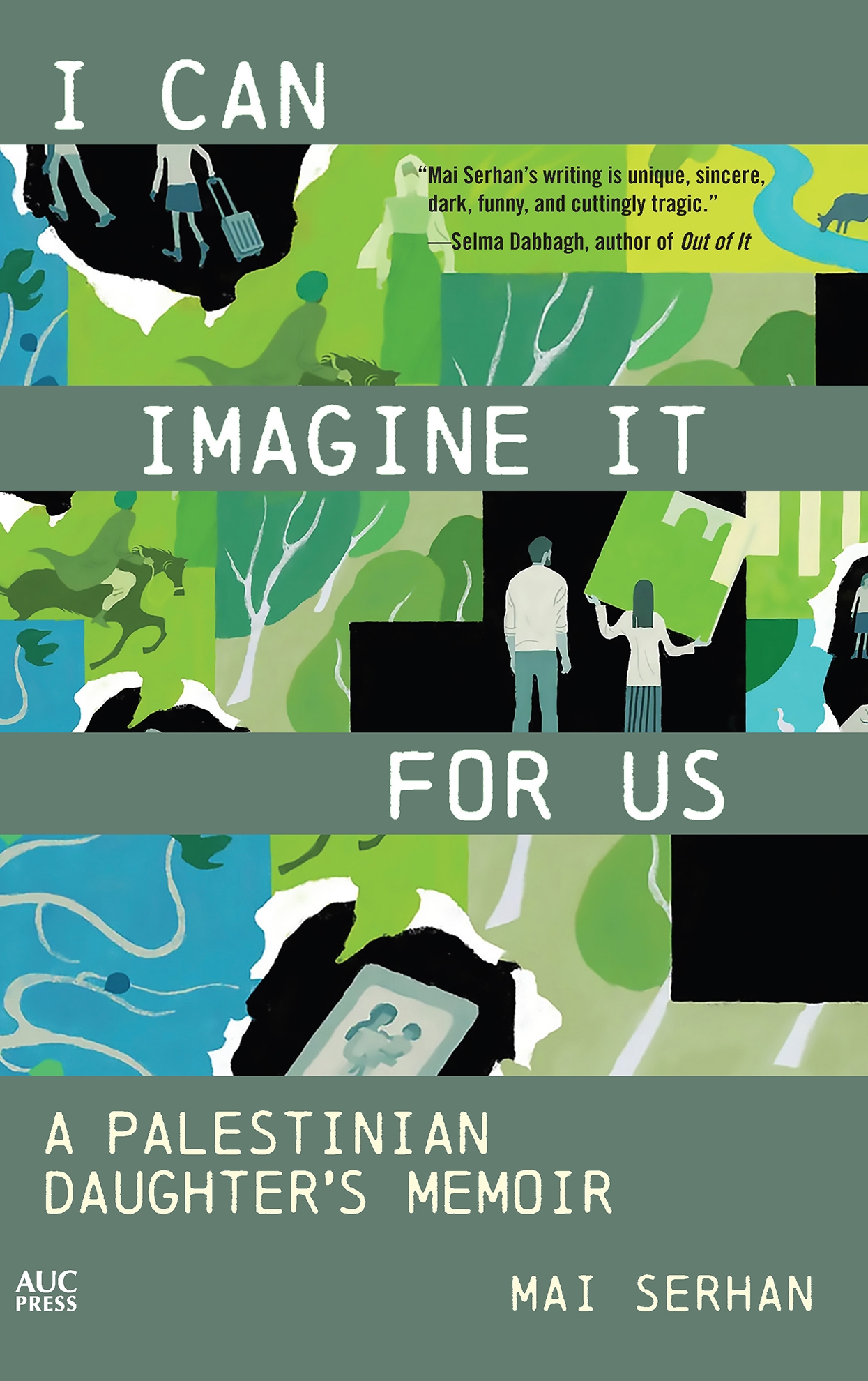
The book begins in Beirut, 2001. Serhan is twenty-four and her father has just lost his foot. Father and daughter share the middle bedroom of the family apartment. The room has no windows. Only a year earlier, when she asked to study literature in London, he’d told her: “You’re not going anywhere.” Instead she could live with her Egyptian mother in Cairo, return with him to China, or remain with her Palestinian grandmother in Lebanon. From this claustrophobic room a window opens onto a life in flight: a father trying to outrun ruins, a daughter who resists but inherits his restlessness.
We zigzag from Acre in 1897, with her paternal great-grandfather, to the pristine salons of Cairo at the turn of the 20th century. Then we come of age with Serhan in Beirut’s nights and Limassol’s summers, through the jarring nine-to-five at an advertising company in Dubai.
If Palestine is the book’s gravity, China is its main plot. There, Serhan follows her father through the trading floors of Shenzhen, Guangzhou, and Yiwu, where he has allegedly built an export empire. In Shenzhen she asks for flip-flops and is met with fury. She uses the Egyptian word ga‘ar – to shout – but he hears it in Levantine as “to bray like a donkey.” This slip of dialect turns into an accusation then violence: a slap across her face, the two of them locked in an elevator, “shooting up like mercury in a thermometer.”
In a sense reading this memoir feels the same. You rise fast in a confined space, dizzy until the doors open and the sprawl comes into view, before you accelerate again. But Serhan conducts the ride and pauses with exacting care: elegant in design, deliberate in technique.
Consider how she places us in the present of her father’s tragic death during a layover in Bangkok. The phone calls, the failed visas, the waiting at airports in Cairo and Beirut; the banging on the door in the night, the missing (or potentially stolen) inheritance in China. Suddenly, the ground tilts. We are in Acre, 1948, where Serhan is asking her father to bear with her as she reconstructs their village. The rooftop under a fountain of stars, the vast kitchens, the horses in their stables. Then, its erasure by Israel: the dynamite against stone walls, the villagers dragged and shot, the orchards burned. That vignette ends with a direct address:
“You can stop breathing now. You can rest,
Mai.”
This gesture, at once the closing of a letter and an address to herself, captures the book’s intimacy. Father and daughter bound through the act of telling, the boundary between them blurring. Inheritance, this memoir says, is not the land they cannot return to nor the profits of an export business, but the story itself, and the voice with which to tell it.
Nowhere is this more vivid than when Serhan, in Cairo in the early 2000s, lays in bed reading the late Elias Khoury’s Gate of the Sun.. Midway through, a howl escapes her. Her mother rushes into the room. Serhan has stumbled upon her father’s village, al-Kabri, where Israeli soldiers during the Nakba attempt to blow up the house of Faris Serhan, her grandfather, vowing they would “occupy all of Palestine and catch up with him in Lebanon.” This moment in Khoury’s novel becomes a turning point for Serhan: the shock of recognition that helps her understand her father and, “by some strange design,” be the one to recount their history years after his death.
Serhan never reduces her father to a villain. Far from it. Still I finished the book wishing for a deeper understanding of his inner life. That very elusiveness, though, is precisely what Serhan has spent years confronting. This book becomes a record of that ongoing effort. We see her reaching toward him, not so much grasping as circling, testing the edges of what can still be recovered or mended after loss. This attempt to connect with a father gone and a homeland under occupation – tentative, imperfect, but deeply sincere – is the book’s emotional achievement.
There are many reasons to read this memoir. For one, its prose is consistently sharp, inventive, stylish. And then there is its singular terrain: as far as I know, no other work has placed two Palestinians within the dizzying boom of early-2000s China. But the memoir’s urgency exceeds this originality. To read it now is to enter the large, intricate world of Palestinianness, assembled through research, oral history, ancestral myth, political imagination, and the fractures of lived experience.
Loss, the memoir suggests, is never abstract; it is a painstaking process of piecing together and rebuilding, again and again, across generations. “War is inside me,” Serhan writes. Few books manage to be so intimate and so geopolitical at once.It’s funny—I read Serhan’s memoir soon after Yasmin Zaher’s The Coin and Maya Abu al-Hayyat’s No One Knows Their Blood Type, searing Palestinian accounts of the repercussions of inheritance: what it is to unravel, to be pulled through the orbits of abusive fathers, debts, cities. All three are voice-driven books that refuse the trap of perfect victims or ready-made scripts. Translator Hazem Jamjoum asks in his afterword to Abu al-Hayyat’s book: “What do we center when we want to speak to us? When we’re not trying to tell others about what we fight against and what we fight for when we fight for freedom?” These writers excavate the stories and bang them against the wall. They examine their war-made, man-made, self-made fractures. They write along and through the fault lines, crooked and persistent. What sprawls is unmistakably their own.
Book cover design by: Alice Yu Deng